Sunday, June 02, 2013

"Library as Place" at Novi Public Library

I have not been to any conferences this year, as I blew my whole travel budget
on one training session for our institutional repository in Berkeley, CA. I wanted to do something small, so I attended the Library as Place workshop coordinated by the Michigan Library Association and held at the Novi Public Library on May 31, 2013.

The sessions were not exactly on Library as Place as I think of it, and the sessions seemed somewhat more appropriate for public libraries, but it was interesting to hear what others are doing, and I especially enjoyed looking at the new Novi library.


The Librarian by
Jim Havens
The keynote speaker was Terry Link from Michigan State University, who has done a lot of things besides being a librarian, including serving as an elected official. He writes a blog called the Possibilitator. His talk on Libraries as the Nexus of Sustainable Communities urged us to look at our values and then work towards making our libraries support those values both in the way we work internally, and in what we provide and teach our patrons. We did an exercise on our personal values in the environmental, economic and social spheres. The kinds of things this group of librarians supported the most were living wages, contributing to the community and organic/local food. At our tables we discussed how we could apply this to our own libraries. At my table we had three academic librarians and we struggled more with how we could apply these values, though the community piece seemed the easiest for all of us to tackle. What I got out of this is that we do need to brainstorm on how we are following our values and in our case our mission. We can say, "Oh, we already support the Learner centered, discovery driven and globally engaged mission of our university" BUT have we really looked at what more we can do to support that mission with our programming.


We are currently offline

The second session was on Business Collaboration, and I was surprised to see Lisa Garcia from WMU presenting on the business outreach center (can't find its official name) and the Michigan Corporate Relations Network. I am not sure what her presentation had to do with library as place, but it was interesting to hear about the different programs and grants they provide the small businesses in our community. Jill Porter from the Traverse Area District Library spoke to the business resources and workshops they now systematically provide to their area small businesses. I liked the fact that they worked closely with the Chamber of Commerce, SCORE, Rotary, etc. If we had more business librarian hours, we could offer more services to our community too. Corey Seeman spoke from the Kresge Business Administration Library at the University of Michigan Ross School of Business, where they have 21 (!!!!) employees and can help their students on the complex business questions, as well as community members. They field reference questions from the outside, including from prisoners and other libraries. They are working on a LibGuide with free and MeL databases available to all residents of Michigan. I liked their message and image when chat was not available (above.)

Three Children Reading by
Randolph Rose at main
entrance
After lunch we had a session on Makerspaces. Jeff Sturges is in charge of the Mt. Elliot makerspace in a church in the Detroit area, where they provide space and materials for community members to build and repair computers, bikes and many other things. They work with digital media (sound recordings, etc.) and wearables. I just recently read about a bike repair place like this letting kids earn their own bike, after they learn to repair it. This seems like a very worthwhile community project, involving all generations where anyone can be a teacher of a skill - it may be an adult teaching a child to use a tool, or a child teaching an adult to use the computer. Then Steve Teeri from the Detroit Public Library explained the makerspace they created in the teen room of their library, which also has bike repairs, but more crafts including paper crafts, sewing & wearables, knitting, graphic design, robotics and Arduino. Their audience is teens 13-18, they have something going on every day and on Saturdays three workshops or more. This brings in teens, gives them a reason to use library resources, and promotes life long learning. Again, not exactly applicable to our library, but we could be doing more programming in our space - maybe related to book crafts, maybe bringing in people at slow times.


Novi Library Cafe
The last session was on bringing dogs into libraries. The first presenters were from the University of Michigan, where they bring in dogs for 3 days, 3 hours at a time around finals. This has become a very popular thing for students. No advertising is needed - they just announce it once and then the students let each other know. They ask handlers to bring in well trained therapy dogs and explained pitfalls and details to consider. Jamie Vander Broek's title at UM is Learning Librarian and Exhibits & Programming Librarian. Again, we lack staff, but this is a great idea to have someone coordinate different programs for the libraries. Tom Shilts was from the Capital Area District Library and talked about service animals and how important they have been in helping vets and children. Another man was from For Better Independence Assistance Dogs and talked about the differences between service dogs, therapy dogs and facility dogs. He had great stories about how dogs have helped people, whether it is a kid reading books out loud for the first time to a dog, or a vet that finally leaves his room to see the dog in the facility.


Terrace
Finally, the Novi Library itself. It is only three years old, and looks like they have considered the needs of the community in creating it. It helps that they are located right next to the high school campus, so when school is out, they get a good number of high school students. When you walk in, there is a desk of people to greet you, and a cafe to the right. Past the cafe was the meeting room in which we had our workshop. The lower level has new books, video and audio, and the Fireplace Lounge - a newspaper and magazine reading room. 

Novi Special race car
Children's room
About half of this lower level is devoted to the children's collection, which includes 4 study rooms, a story hour room and activities room. The main room has on display the Novi Special, race car of special importance to the town history. The second floor contains the adult reading room, quiet study room, 5 individual study rooms, teen room (teen fiction and some game consoles), computer lab, and plenty of computers for all to use. The local history room was still under construction, and there was a board room that can be used by community groups. Info (reference) desks on both floors. 

Plants and flowers Life Tiles
by Connie Lunski
Throughout and around the library there is plenty of art and sculpture. The most impressive was a collection of 1,600 ceramic Life Tiles created by local artist. They were displayed throughout the library in groupings by different parts of the world, stories, transportation, plants, etc. I also like the Glass Apples.
Glass Apples by Richard Ritter.

Monday, October 01, 2012

Kent State University Library

I had research reasons to visit Kent State University Library. I knew 30 years ago that they had a substantial Baltic collection, but had never visited it, and was wondering what was going on with that collection. The collection is now mainly in storage, and is minimally used, thought there is some renewed interest from the Lithuanian community.

While visiting for one purpose, I am always curious to see what other universities have done with their library space. The Kent State library building is 12 stories tall, but only three of those contain books at this point. The top floors contain special collections and government documents, a couple still contain print periodicals, one floor has the School of Library and Information Science, but four floors are devoted to student study space of various kinds.

As I entered the building, the first thing I saw and heard was a reading of some sort going on, and a couple of dozen people sitting or standing around listening. Right in front! As soon as I walked through the gates!

To the right, again, as soon as you walk into the library, the cafe - selling Starbucks coffee, tea, smoothies and a few pastries. Not elaborate, but there, right inside the front door, as I have seen it in so many other libraries.

I went upstairs to my appointment in the special collections, and afterwards worked my way down from the top floor, but I will explain what was on those bottom floors first. The first floor contains the Circulation Desk and Information Commons, which includes the Reference Desk and Reference collection , Express Multimedia Stations, Student Multimedia Studio, Quiet Study Area, Group Study Rooms, May 4 Resource Room, Computer Lab, Group Instruction Lab, and Math Tutoring. That is the official list on the right. The reference collection was in about six half height shelves, (see left), four shelves long. The reference collection and desk also serve the government documents. There was also printing, the cafe, presentation area, and a nice display of all the current bestsellers in their jackets, like one would find at a public library. (Why do we hide ours behind the circulation desk?)

The second floor was another open space with a help center and Math Emporium. I am not sure I totally understood how that works, but it was a huge computer lab for online math courses, with people there to help, when needed. Interlibrary Loan, a periodical and microfilm help desk and student lounge are also on the second floor.

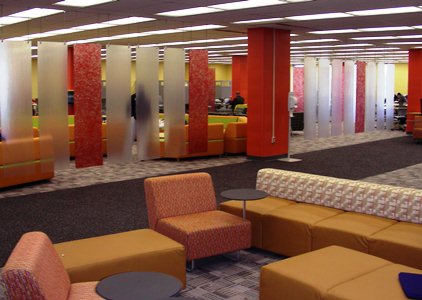
The third floor contains offices and the School for Library Science, but the fourth floor is another open space with comfy seating, hanging partitions and included the Writing Commons. The fifth and sixth floors had periodicals, and one was designated as quiet study space. 7-9th floors had books, but of course they all have study spaces too. My understanding was that they have done major weeding and most of their collection is located in off site storage. It is obvious they have not done it all at once. There are plenty of old tables and chairs in the upper floors, but it looks like they have taken one space at a time and made it pleasant, and useful to the students.

I hate to sound like a broken record, but I hope we get back on track and plan for the physical reorganization of our library with a cafe up front. I don't think it matters that there is a nice cafe in Sangren Hall, the students are coming through our doors (and we have numbers) and need more than vending machine coffee to keep them going. We need to keep talking to the Writing Center and other help centers for students, to see if we cannot combine these services. And for just a small doable right now idea - how about putting all the best sellers in that empty corner next to the WMU Authors reading area? With covers, appealing, available for a quick read.

Saturday, May 12, 2012

University of Michigan Libraries

I cannot pass up the opportunity to visit libraries when I am at conferences, and I had heard about renovations that University of Michigan had done to both its undergrad and grad libraries, so after the MLA Academic Librarians conference I went to take a look.


Shapiro Undergraduate Library has the new cafe - Bert's Cafe, named after the donor. As you walk in the door, there is a sharply angled information desk in front of you, the cafe with various seating arrangements to your left, and some comfy chairs and numerous screens flashing library and university news. The information desk functions like ours, but it also has books that are on hold for people.


Then there are doors into the library proper, where the first thing people see is the reference desk, with a minimal reference collection in low curved shelves. Actually, most of the book shelves on this floor were curved and you could see over them. Right next to the reference collection there was a small new book area, and on the other side about 24 work stations. The center of this large room was filled with rows and rows of tables. (Would love to see how this area works at finals time.) Then towards the back there was a magazine collection, and a browsing book collection. (Yes, yes, we need this!) The literature section was in, guess what? - alphabetic order by author! What a concept! The non-fiction was by call number, but had labels - history, psychology, cookbooks, biology, etc. The books were new or popular and often in paperback.

The most surprising area to me was Reserves. These were in open stacks along the back wall of this main room. I talked to the person working at the circulation desk, also in the back, and she explained that they have had this set-up for about a year, since they remodeled. Students just take the books they need and read them on the spot. They can check them out for four hours and then leave the library with them. Any material owned by an instructor, and a few of the very popular books are kept in a locked cabinet behind the desk, but the cabinet was only about 4 x 6 feet. Books on CD were also in these open stacks. I asked if U of M students were competitive enough to hog reserve materials, and she just said that U of M students ARE competitive, so I would love to talk to someone more about any issues they have had with open reserves.

This floor had three group study rooms, one presentation, one editing room, one reflection/meditation room, an Adaptive Technology Computing Site (like our METL lab) and a fairly large partitioned room for project support. They advertised help with Adobe Illustrator, Photoshop, Word, PowerPoint, RefWorks and video editing. I could see a poster printer in there.

The second floor had 12 group study rooms that I could see, and it looked like they were almost all in use even now in the summer.


I didn't spend much time in the Hatcher Graduate Library, but walked into an impressive space from the bridge from Shapiro - the Stephen S. Clark Library for maps, government documents and digital imaging (mostly GIS related.)  Hatcher is an old beautiful building with a huge old fashioned reading room, as we once had in the North Hall.

I was mostly interested in the lower level, where they had moved out the technical services offices to create a gallery space. I heard it does not get used enough, but there was an area for performances, nice permanent exhibit space called the Audobon room, but there was an exhibit of the Labadie anarchist materials (that were referred to by the last speaker at the conference), there was an instruction classroom, and movable exhibit walls with an exhibit on languages that looked interesting. The fourth floor had an elegant Asian Library.

Enough for a short visit. We at Western need to keep talking about our own space and take a clean floor plan of the first floor Waldo and decide what and where we really need things.


Library of Congress

In March I had to visit the Library of Congress to check on the Baltic materials there and had not calculated travel time adequately, so I only had a few hours and that was not enough. So I had to forgo ogling the amazing Great Hall, which I saw being renovated in 1992 and then completed at a conference reception some years later. I also did not set foot in the famous Main Reading Room this time.

I had gotten a reference question from a friend in Chicago that morning. He is an engineer researching Latvian archaeoastronomy in his free time. In an obituary he read that a man had published articles on this in a nature and history calendar (Dabas un Vestures Kalendars) of 1970-72. Could I help him find copies of this. I know we had this publication and these years at the Latvian Studies Center Library. I am not completely sure, but I think that the University of Washington didn't take these as they don't collect calendars, not realizing that the calendars from Latvia are hundreds of pages long and consist of articles. So I checked WorldCat - 8 libraries in the U.S. own this publication, but most did not list holdings or the ones listed were too recent. The Library of Congress is one of the libraries listed, so I write down the call number, as this is the day I am visiting LC.

I walk into LC and the sound of tourist voices echo in the Great Hall. I stop at the information desk. which is like those for museums or other tourist places with maps, guides, etc. I take them, but ask for the European Reading Room. He gives me directions through a maze of corridors. I see a sign that says "Staff and Researchers only." I almost turn back and then remember, oh yeah, I am a "researcher." Now I have entered the real hallowed halls of LC.

I remember the European Reading room was in upheaval in 2008 when they were thrown out of their space to provide more exhibit space. Now you have to go through the Hispanic Reading Room to get to the European Reading Room. You open these huge twelve foot doors and walk into a mini main reading room with a gilded dome ceiling. At the desk is a familiar face - Harry Leich, one of the few LC people I have known for years from various Slavic studies conferences. It used to be a room for receptions, but now houses the reference materials for the seven most popular European countries and work space for researchers. Printing is free. There is an overflow reference stack area for the other countries, including the Baltics. We walked past some very nice offices in a two story dark wood structure. There was an area for copy machines, microfilm readers/printers, etc. Their latest gadget was Book2net, a book scanner. You set the book down pages up, put in your flash drive, and push a button. It had its glitches, but I used it successfully.

To get to ask for the calendars I wanted for my friend, I needed to get a Reader Card in the Madison building next door. OK, this will be a good experience in seeing the process a researcher has to go through. Most of my previous visits to LC were to catalogers in the Madison building, one of the most confusing buildings I have ever tried to navigate, even though they have tried to color code the corridors like in my childhood Parcheesi boards. Harry suggested I use the tunnels, so I didn't have to go outside or through security again, so I wound my way through the maze, though at one point when I was looking for an elevator, an elderly reader pointed it out to me with the comment "You looked like a tourist - no insult intended."

Registration was painless - you show your ID, they record it. Then you sit down at a computer and fill in your address, age (16-17 or 18 plus) and status. I could indicate I was a faculty member. I also had to fill out some of the same info on a paper form. Then a person pulled up my data, snapped a photo of me, and voilà I now have an LC Reader Card. I should be in the system permanently, but need to renew the card after two years.

While in the Madison Building, I checked out the Prints and Photographs division, that has some Baltic materials. Their restrictions were even tighter than at the Historical Society of Pennsylvania. I was only allowed o bring in loose paper (no file folder), my iPad (but had to take it our of the case) and my camera (sans case.) While I was there, cartoonist Pat Oliphant came in and was being helped, the librarian helping me was excited. I still can't say I get half of what is in these collections, but it is a room full of vertical files of images and card catalogs and finding aids. Of course there is the online catalog to many of the images, and so many of them are old enough to be out of copyright that they have been digitized and are available open access. But there are lots of collections still with only card catalog or print finding aid access and a number of unprocessed collections. A simple, but cool reference tool they had was a sheet listing of all the various collections they have that a researcher can use to map out what collection has something pertinent to their research, and so they remember what they have looked at and what still needs to be checked. I keep wondering how we could adapt it in our library for those difficult marketing assignments or just general research.

I returned to the European Reading Room, ordered my calendars, made my copies, and emailed them to the friend. I knew that he would be impressed, but had to laugh when he asked where he could nominate me for a Emmy/Grammy/Oscar for librarians.

MLA Academic Libraries Conference 2012


I had never attended the Michigan Library Association Academic Libraries Conference before and found it useful forum to connect with colleagues across Michigan academic libraries. The regular MLA conference in the fall tends to be too diverse, as is ALA with the wide variety of libraries and vendors represented. Michigan Academy draws a very small group of academic librarians, so this must be the place to be. This was the last of four conferences I attended in five weeks, so my enthusiasm level was a bit low, and it pulled me back into my regular library work, away from my sabbatical themes, but was worth it. Since I have a million and one things to finish before I leave on my sabbatical trip, I will keep this brief.


The keynote speakers were great. I never get tired of hearing Megan Oakleaf, and I figure if I hear her talk about the value of academic libraries enough times, I will actually do something about how I communicate our library impact to the rest of the university. I have to use her type of language in communicating about ScholarWorks. The three hour workshop really helped us think about what our stakeholders want and what we could be doing. As a simple "to do" I wrote down that we should at least redo our Fact sheet to reflect what those numbers may mean to people on campus.

On Thursday I also attended our own librarians' presentation on information literacy for the millennials, and their comparison of Searchpath, the tutorial I worked on years ago, and their updated version ResearchPath. I also went to hear U of M people speak of Digital Humanities. I have heard the term at WMU, but was not clear what this referred to. These two men have been giving introductory sessions to humanities folks on how technology can help them in their research - to crunch data in ways they never could. I will try to look at their Digital Humanities LibGuide - http://guides.lib.umich.edu/digitalhumanities . The best idea I got from their session is having special interest groups in the library - they call them SIGs. This is an ad hoc group that meets around a special interest, so the one for digital humanities is called digSIG, and they have another on 2.0 issues that have now evolved to using iPads and social networking in library work.

Friday, besides presenting with Sarah Beaubien of Grand Valley and Kelly Jacobsma of Hope on our scholarly repositories, I went to the session on demand driven e-book purchasing and two on weeding projects. I just wanted to be sure I understood the state-wide weeding project in which we are participating, so I could explain it oversees, if anyone asks. I also had a nice talk with the dean of Northern Michigan libraries, as they too will start using Digital Commons. Sarah is planning a user group for the Great Lakes area, though the first meeting will be while I am gone, but I hope Lisa can attend.

The conference ended with Ari Weinzweig of Zingermann's, my favorite place in Ann Arbor. I had visited the deli the evening before and stopped at their Roadhouse on my way to stay with friends. I have heard a Zing Train presentation on how to make your workplace a better, more engaging, more successful endeavor, but how easily one forgets. As one colleague said - let's make our library work like this. I liked his examples of what a vision statement should look like (very different from ours, I believe), so you know where you are going. There was a lot about having fun, about being involved and learning about all aspects of your business, so all employees feel committed, and about helping them be successful in their lives as well as work. (We are sorta doing this with the wellness program.)