Wednesday, March 19, 2014

Yale Conference on Baltic and Scandinavian Studies 2014

Just got back from what I consider the AABS conference, but above you will see
it’s official title. I am again motivated to get back to work on my own research, so I think it is money well spent by me and my institution. This is the second time the Balts decided to have a combined conference with the Scandinavians, and though I see overlapping themes and some joint sessions, I am not sure this is the best for Baltic studies. There were close to 530 attendees from 22 countries and 39% were AABS members, so roughly 200 with interest in the Baltics. I don’t know how that compares with the last conference in Chicago, but there were a good number of grad students attending, so I feel Baltic studies are alive and well.

As in all conferences, there were various tracks with presentations on minutiae that mostly interest specialists, but I found something interesting to attend in almost all the time slots. Only in the very first session I had no preference and chose a room, because it just looked cool with stained glass and had plenty of seats, so I could go through the program and choose what I was going to listen to throughout the conference. With one eye and ear I vaguely followed a session on Viking archeological digs. What I got out of it was that Vikings were buried with their horses, dogs and weapons, sometimes in boats. The keynote was also on Vikings, or more specifically – Beserkers – an especially crazy, violent form of Vikings. A renown Yale professor – Anders Winroth – started with the word “beserk” as used in newspapers and elsewhere in the last 100 years or so, went on to references of Beserkers in 12th century sagas, to various linguistic explanations of the word – weather it meant bare-skinned, or bear skin covered or chain mail covered. I enjoyed watching this man make his argument.

The reception was held in the Yale's Beinecke Rare Books & Manuscript Library. It was one of the few times where we could mingle with all of the conference attendees. I stood in a food line with a grad student who had always defined himself as The Viking, and was now disconcerted to be amongst so many Vikings. It was a pleasure to run into three delightful folks from the Herder Institute, who reminded me that the next European Baltic Studies conference will be held at their institution in September 2015. Wonder how I could get to that?

There was no bibliographic track and the only session I would categorize as
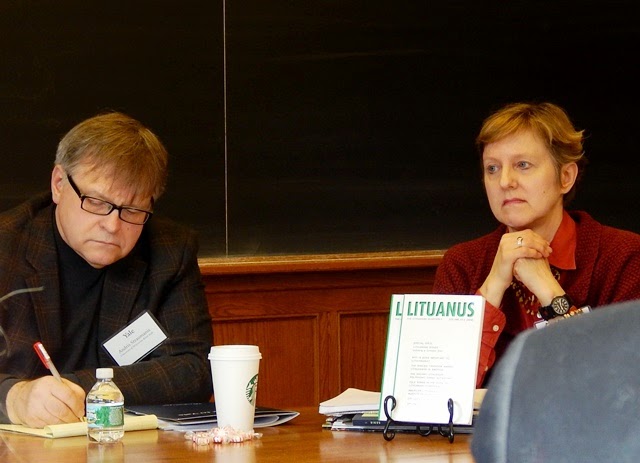
being library focused was on émigré Baltic Press, where Andris Straumanis had again done solid research looking at how the word “veclatvieši” or “old Latvians” had come about and how that first wave of Latvian emigrants was described in Latvia and in the émigré press. His paper was full of useful facts and numbers. Erick Zen (he actually has a much longer full name) surprised me by being from Rio de Janeiro and talking about Lithuanians in Argentina and Brazil. Violeta Kaledaite from Vytautas Magnus University discussed the publication Lituanus, one of the two scholarly publications on Lithuanian issues in English. My oldest acquaintance in the Lithuanian community, Ramune Kubilius had a very nice overview of current Lithuanian publications in English. I should ask her to contribute to my handbook.

I ran into Ivars Ijābs from the University of Latvia on the street and went to his
presentation on the evolution of Latvian nationalist thought through maps. I had never seen the early maps of Latvia that did not contain the Latgale region and had no distinct border at the north dividing it from Estonia. The first map that included what we now consider Latvia was printed in 1890 and the use of the term “Latvia” started in the 1860’s. It was fun to watch the Lithuanians squirm, when some of the maps took a broad sweep of Latvia that included Lithuania too.

There were many simultaneous sessions, but at least they were all in close proximity, and I would hop from one to the next, even within one session, so I only got to a part of the round table on BATUN, the Baltic Appeal to the United Nations. I heard Māra Lazda speak and she will be the next AABS president. This session led to some of the most useful discussions for me. First, I heard them ask the presenters, if they would be willing to share their presentations, and it was left up to people emailing each other. I just thought „Sheesh, if they were using our institutional repository platform, had the conference schedule up in that, they could just add their presentations, and they would be available to everybody.” The Administrative Executive Director of AABS, Irena Blekys, was there, so I started talking to her about this. Then it evolved into a conversation about how AABS and BATUN archives should be saved, organized, digitized, etc.  Irena asked me to write an article for the newsletter.

There was a whole series of sessions on the Singing Revolution theme. I wanted to hear Guntis Šmidchens speak, so I went to one of those sessions and got to also hear Janis Chakars, who will organize the next AABS conference in Philadelphia, and Bradley Woodworth, who heads the Baltic Studies program at Yale and was the main organizer of this conference. The Singing Revolution is an engaging topic raising questions on the role the Baltic States played in the fall of the Soviet Union, did they show how a David can slay Goliath, what role singing had in it, did the fact that choirs are inherently democratic have an effect, etc. At this session I also ran into Joseph Ellis from Wingate University in NC, who had taken his students to Estonia after teaching a class on the Singing Revolution. We presented at the same session in Chicago and he was recognized with a reward at the AABS meeting.

I heard Vilis Inde talk about translating a Latvian classic – Rainis’ Zelta zirgs into Golden Horse. Inde first went on a tangent on the importance of having quality English translations on Latvian websites. He had spent months trying to convince the organizers and Latvian government to clean up the Riga 2014 site, meant for tourists who will visit Riga during its year as the European Capital of Culture. I found it interesting that he had translated the book for his nephews, so that they would have a point of connection with their grandparents, as that generation often does not read contemporary Latvian fiction.

I wanted to hear what the Latvian language teacher at University of Washington had to say about the difference of heritage and non-heritage language students, but stumbled into a great presentation on evaluating Lithuanian language skills through a natural context. I missed how she had set up these “interviews,” but she asked people whose first language was Italian, Russian, French, etc. and who had lived in Lithuania anywhere from under three years to over 15 years, to describe things, or give a recipe (for imperative forms), and then analyzed their language. She also asked them about their motivation to learn or not learn Lithuanian. Fascinating. Some were eager to learn, so they would fit in better, others felt no reason to and had not learned anything besides very basic courtesies in over 15 years. Iveta Grinberga, the Latvian instructor for UW had done a preliminary study with two students of different backgrounds. The non-heritage student had more difficulty with cases and tended to simplify the case system. The heritage student, who had at least heard the language in childhood, tended to do more code mixing – substituting English words for Latvian. Looking forward to more of her research.

Agita Misāne of the University of Latvia explained to us how the Namejs Ring became a tradition. Namejs was a political and military leader in the late 13th century, but there is no historical basis to connect him with any ring. Archeologists found a plaited ring, but in a different part of the country and from about 100 years earlier. Writer Aleksandrs Grīns wrote a book in 1928 titled Namejs Ring, though the ring he describes is different. Grīns story was eventually performed on stage and later someone presented the President Ulmanis a ring they called a Namejs, and painter Liberts painted the archeological ring on the finger of his fantasy portrait of Namejs. Later Ulmanis' connection to the ring was forgotten and it became a symbol of identity in the exile community and in Latvia, a symbol for supporters of Latvian independence.

I sat through a whole art session, where Anna Romanovska talked about
thinking of her past life in colors - dark ones for difficult parts of her life, bright yellow for shoes her mother had purchased for her abroad, etc. She had an amazing sketch where she had managed to display the lives of her family as intertwining colored timelines. I think this would be a fun way for displaying a family history. Mark Ian Jones from Australia talked about Swedish and Scandinavian design that was very popular 1950-70. Then my friend Mark Svede talked about the Latvian artist Andris Vitoliņš, making sense of things I would not have understood on my own. The session ended with Zivile Gimbutas talking about Lithuanian artists Ciurlionis, Vizgirda and Virkau. Mark suggested that we also listen to Alise Tifentale, who he considers the brightest new art historian for the Latvians. The title of her presentation had caught my eye: "Our Muddy Boots on Their Marble Floor..." She looked at artists Kaspars Podnieks and Krišs Salamanis at the 55th Venice Biennale in the Latvian Pavilion in 2013. Podnieks has done portraits of farmers that look simple, until you realize they are suspended a few meters off the ground. Salamanis had a large tree swinging upside down from the ceiling of the hall.

All in all a good conference. It was fun to walk the hallowed halls of Yale. The conference was bigger than they expected, so some rooms were quite crowded and there wasn't really any room to hang out, but Yale had nice simple wifi access for guests. And there were plenty of restaurants to eat at close by.

Tuesday, March 04, 2014

Michigan Academy 2014 at Oakland University

As usual, I really enjoyed my time at Michigan Academy of Science, Arts & Letters. This is a one day conference, where all the library sessions are in one room and we get to hear what everyone is doing. The topics are all over the place, but that is what I like. The Library & Information Sciences is one of the largest sections in the Academy with consistent attendance, so I continue to support this gathering of Michigan (and surrounding area) academic librarians.

I like visiting the different universities across the state, and had never been to Oakland University. It was founded in 1957 and is still expanding in its wide open territory (1444 acres!) in suburban Rochester. I always visit the libraries, but this time we ran late, it was very cold and I had an errand to run in Dearborn before returning home, so I will have to visit their library at another time.

Mike Unsworth from Michigan State talked about an interesting collection he is working with – the illustrations from the Chicago Tribune from the 1880’s to the 1940’s. The scans are much higher resolution and in color, than the ProQuest scans of newspaper microfilms. The illustrations include the usual photos, but also drawings, comics and advertising. Student workers have entered in the basic descriptions, but Unsworth is adding subject headings and other details to make this a really valuable resource for students and researchers.

I talked about the importance of national libraries in the Baltics, thankful for the nudge to work on my research again. People seemed interested, as I think we don’t know enough about what libraries outside of the U.S. are doing.

Arjun Sabharwal from the University of Toledo talked about the impact of social networking on digital heritage collections. He talked about a network of institutions and repositories working together with the help of social curation to create virtual collections. He mentioned HASTAC (pronounced “haystack”), which has been mentioned in our digital humanities group; Changing Faces of Brooklyn - a crowd curated online collections at the Brooklyn Museum; and StoryCorps “Celebrating 10 years of listening to America.” His own site is Toledo’s Attic. He has integrated the site with Facebook, Twitter. Instagram, Flickr, Pinterest, YouTube, and a wiki and a blog and people can contribute and comment. For example, he has gotten videos of Toledo from YouTube and put a selection on his site. Historical postcards of Toledo are on Pinterest. During the question period one of the medical librarians mentioned that there now is a PubMed commons. If you have something in PubMed, you can create an account and comment on articles. I liked the term “participatory archiving” – maybe something we can do in the Latvian community – or even at Western.

Karen Liston from Wayne State talked about graphic novels and information literacy for language learners and area studies. She told us about the fun, but also difficulties, she has had in finding and managing a graphic novel collection for the many languages in her liaison area. She has created a graphic novel page in her LibGuide for Modern LanguageStudies. She has found a graphic novel for each of her languages, though many are not found in her library. One interesting example was Boxers  and Saints, two graphic novels by Gene Luen Yang about the Boxer rebellion in China 1899-1901 – one from the internal view point, one from the Christian view point.


Chris Miko from Bowling Green State University talked about improving undergraduate information seeking practices. He talked about a learning community at his institution where librarians and teaching faculty met over a year to discuss the research practices of undergraduates.  It sounds like it was a valuable experience for all involved. They came to the conclusion that faculty don’t define research enough and don’t involve librarians in the process enough. They also looked at a survey of faculty and students, who answered the question what students found most difficult about the research process. Students themselves found the writing  most difficult, while faculty thought it was assessing sources. He is looking for ways to share this with the rest of his colleagues and continuing the discussion with faculty. There is a Bowling Green LibGuide on library basics.

Keith Engwall and Stephanie Swanberg are from the Oakland University Medical School that is in its third year with 223 students. Their medical library is mostly digital with a few print text books. The librarians are part of the School of Medicine faculty and are integrated in course development. All students have to do a research project over their four years and write a paper. What Keith and Stephanie experimented with was using chat to supplement class instruction. One of them would teach a class and the other sit in back monitoring a special Moodle chat session with the students in the class. The students needed prompting, like being asked to paste in a search strategy into chat, and then Keith could respond, though when everyone did it at once, he could not respond to all of them.

Todd Wiebe from Hope College had the most entertaining presentation titled:  “Who do they think they are? IL mastery or illusory competence of first year college students.” Wiebe scattered his presentation with witty and targeted quotes, such as the one from Darwin: “ignorance more frequently begets confidence than does knowledge” (from The Descent of Man (1871) as found in Wikiquote by me). Wiebe went on to tell us how he tried to assess IL success of an introductory English class that all Hope students have to take.  He chose to go with the indirect method asking for self-perceptions of research skills and he predicted that freshmen would be realistic about what they don't know. He found that 70% thought they had good or excellent research skills. He started looking for studies done by others on inflated self-assessment by students and found that Kruger & Dunning had published a study in 1999 titled “Unskilled and unaware of it.” He mentioned other studies and suggested that we give students wake up calls earlier and that we don’t need to be as polite as we librarians tend to be. He has asked students to come in with two sources they think are good and then he critiques them and offers other sources.

Ed Eckel from Western Michigan University spoke about writing ethically and well and educating graduate students on proper writing practices through plagiarism workshops. Ed has found how hard it is for students to learn to write independently and not patch write, as is often the case. He has worked with the Graduate College to offer a series of plagiarism workshops that have been well received. This presentation was a catalyst for lots of lively discussion.

Julia Rodriguez from Oakland University shared how she has done open access training for library faculty, which she then hopes to expand to the rest of the university. She had an overview of all the recent changes that have happened to facilitate open access and listed all the new staff and faculty that have been added to the OU library. There were some good tips on training, such as having everyone write their elevator speech on open access and then voting on the best one. They used Padlet - http://padlet.com/ for this – one more new app I didn’t know about. During the Open Access week they held a panel on the challenges of traditional publishing.


Michele Bass is a University Library Associate at the University of Michigan who talked about her apprenticeship at the Taubman Health Sciences Library being a good training program for her becoming an informationist. The Taubman library is being renovated, the library books are in storage, and the space is being developed more for use by users. Bass answered the question “What's an informationist?” by explaining that librarians do not just provide support services, but are partners actively contributing to the work of the university.

Steven Putt and James Van Loon from Wayne State University presented on developing research data services. We have been discussing this at our library on how we can participate more in the data intensive research process, especially in the sciences and business. The need for data management plans, digital curation of data is being mandated by funding agencies, but also facilitates research efficiency and interdisciplinary research. Subject librarians and libraries can be part of this process, not necessarily providing data storage space, but helping investigators formulate a data management plan and suggesting places for storage.

Merle Rosenzweig of the Taubman Health Sciences Library at the University of
Michigan described the implementation of Open Researcher and Contributor ID (ORCID) at her institution. ORCID is being used as a disambiguator of authors and being adopted by publishers, institutions, and funding agencies. When submitting articles, publishers are asking for and some are requiring ORCID numbers. U of M now has an agreement, which allows them to create ORCID numbers. Every medical school faculty member has to have a CV online and they are working with Mcommunity directory to have ORCID number included.

Arlene Weismantel and Jonah Magar of Michigan State University shared their insights on the academic library as publisher. In the recently published Library Publishing Directory - 110 libraries report that their institutional repositories are publishing journals, electronic theses and dissertations, and more. This Is a good way to disseminate and preserve materials, make rare and out of print materials more available. Most libraries don’t try to compete with publishers, just proved a service for publications that publishers won’t touch. The libraries at Michigan State collaborate with their university press to provide a publishing service. Magar works with the Espresso Book Machine  and acts as a guide to many self-publishers. They have compiled and reprinted books from MSU’s past. He will help proof copies and walk people through the self-publishing process. There are guidelines on the website and in a booklet they published – Publish Instantly: Submission Guidelines and Best Practices – that I find very useful. There is a catalog of 7 million books available on demand. They also work with the community. My greatest take-away was, that we could use them as our print-on-demand service, as we will not be purchasing the quarter million dollar Espresso machine anytime soon.


Kristina Eden from the University of Michigan looked very familiar and we figured out she had interned at my library years ago. She works with a Copyright Review Management System that collaborates with other institutions. For me it was a fascinating look into the back end work of the Hathi Trust. They are working through a portion of the 11 million volumes Google Books has digitized to see which ones can be made open access. It can be difficult to figure out if something is in the public domain. They have finished looking at books published in the United States between 1920-1963 and were able to make 105,000 of them open access. Their next focus will be on the U.K., Canada and Australia. This work is being done by various institutions funded by grants. A reviewer interface has been developed where you can put in the country, automatically look up when an author died, and follow a decision tree. To achieve legally reliable and consistent results, they have developed a centralized training system with videos that are followed by a one on one screen sharing session as trainer observes the trainee. Two people review each item and if they disagree, an expert adjudicator is called in to make the final decision.

Mike Hawthorne, Katrina Rouan, Alexandra Sarkozy and Nancy Wilmes from Wayne State shared their new model for patron services at the Science & Engineering Library. The decision was made to close this branch library as gate counts, circulation and reference questions had gone down steeply and much in science and engineering is available electronically. The building is still being used for two computer labs, and the books are remaining on the shelves, but are available only by paging. They did purchase a virtual shelf browsing program. The library staff have mostly moved to the grad college library, course reserves have been moved to the 24/7 undergraduate library. They did lose some study room space, but replaced them with larger study rooms in the undergrad library. Closing the library has had them look at their collections and for reference they have had to choose to pitch it, store it, or bring it over. Some high circulation monographs and remaining print journals were also moved. Most new purchases are electronic, and the new print materials go into the grad library. They have made a one-time purchase of various back files. The new model of patron services relies heavily on electronic access to journals, paging access to print, document delivery, phone and chat reference, though liaisons continue to provide instruction and research support. The library has saved a lot on operational costs. The transition has been fairly smooth, as communicating with the campus was a priority. Each department was visited and the academic senate, student association and other key committees were informed. The closing was postponed from August to December 2013 to allow everyone to understand the upcoming changes.


Good conference!

Friday, October 18, 2013

Michigan State University Library

I am embarrassed to admit that I have never visited the MSU Library. I have come to Lansing numerous times while I have lived in Michigan, but it has always been for some specific purpose that did not bring me near the library. I have visited the Library of Michigan at least three or four times, I used to come to Michigan Library Consortium events, but for whatever reason, did not visit MSU. I am amazed that at many conferences where librarians meet, I see no curiosity in visiting the local libraries. At Michigan Academy I find that I am often the only librarian who chose to visit the host institution's library and talk to their staff. This time I was in Lansing for the Michigan Library Association Annual Conference and was forced to come to the MSU library as I had to pick up the key of the house I was staying in from someone that worked in the library. It was my intention to visit the  MSU library anyway, so this just gave me the extra incentive.


When I asked where I could park, my friend suggested the stadium parking lot. I have to admit the Spartan Stadium felt massive compared to Waldo Stadium, but I remember in my brief time working with the Ohio State women's volleyball team, that the Ohio State stadium was also overbearing.

The library itself is the typical older academic library. Someone at the conference asked me why Western didn't have a new library, when Eastern, Central and others had built new library buildings recently. I explained that we had just gotten a new Education Library and Archives, and that the Waldo renovation was not that long ago. I am fine with our building in general, it is that we have not reorganized our space since that renovation to fit the new needs of our patrons. My main purpose in visiting other libraries is to get ideas for changes in our own library. 

The MSU library has five floors in two wings that are connected only on the bottom two floors. One wing is the "quiet wing" that holds most of the LC classified books and has mostly individual carrels for studying. The other wing has more of the group study rooms and spaces, conference rooms, government documents, maps, current periodicals, the copy center and reserves, fine arts collection (art and music) and the Digital and Multimedia Center.

I asked the reference librarian about their groups study rooms and she said they did not have enough. They have six Collaborative Technology Labs, which have to be reserved (online) and about as many simple group study rooms. I saw places that were just divided off with office room dividers for group use. There was a large fairly loud group working together right in front of the reference desk and the librarian said they had no rooms to accommodate a group of that size.


As in every other library I have visited recently, there was a cafe, the Cyber Cafe, serving high quality coffee - by that I mean having the fancy machines to make espresso, cappuccino, etc. with flavors, etc. They offered snacks like chips and candy, and had one display cooler of more substantial food like sandwiches and salads. There was a fairly large area beyond the counter with tables for eating, socializing and studying.

The first floor had various special collections on display, such as the faculty book collection, Cesar Chavez Collection, browsing collection and new books. The Writing Center had a space not far from the reference area, that they staff Sunday through Thursday 5-10 pm. They said that they had satellite writing centers throughout campus. The reference collection has once again been pared down to a small used section with low shelves, maybe the size of our index shelf area that we are cleaning out.

They have a combined copy center and reserves and on a wall near-by they listed the services this area provides: printing and copying, poster printing and laminating, scanning and faxing, supplies, course reserves, course materials program, and an Espresso book machine for printing on demand.

They have a Digital and Multimedia Center, which also includes the Vincent Voice Library and Technology Labs. My understanding is that this is where they keep all their audio and video recordings and the equipment to listen to and view them. There are staff that can help students create multimedia materials, and I heard someone refer to this area as being the place where things are digitized. This is also the area that contains the ONLY GUEST access computer. There is a table of computers for using the catalog and library resources by the reference desk, but to look at email and Facebook and surf the Web, there is only ONE computer for non-MSU folks. I did not ask about wireless access.


One last comment on signage. It has been noted that it is difficult to find one's way around big academic libraries. MSU's solution is to provide signs and colored tape lines to lead people to the correct areas. They do not have carpeted flooring, so the tape probably works better on their tiled floors, but it is an idea. It also assumes that things will stay in place for a long time, as I can't imagine redoing the tape for every shelf shift.

Saturday, August 10, 2013

Digital Commons Great Lakes User Group Meeting

August 8-9, 2013, held at Illinois Wesleyan University in Bloomington, IL


Jacklyn Rander & Sarah Beaubien of GVSU, Sarah Shreeves
of Univ. of IL Champaign-Urbana and Stephanie
Davis-Kahl of Illinois Wesleyan University
About 30 Digital Commons users from eight states gathered in the Ames Library for this useful exchange of ideas. Dave Stout, our area sales manager from bepress was there to greet us as one of the most active groups of DC users. There are now 322 DC customers, up from 50 six years ago, with 69 new sites in 2012. There are 1.3 items in all the repositories, with almost 70% full text that have been downloaded 145 million times with an average download of 162 times per object.

Stephanie Davis-Kahl was the local organizer (I met her at the repository manager certification), while Sarah Beaubian of Grand Valley had organized the program. Stephanie mentioned a great list of things that had happened with open access this year alone, including the federal and other funding agencies requiring open access to work done with their monies and the White House Open Data Policy.

Since next year’s focus for ScholarWorks will be on faculty publications, my new ScholarWorks grad assitant and I were happy to see sessions that focused on getting faculty publications into the repository. Margaret Heller form Loyala University in Chicago talked about searching for current faculty article publications, importing them into RefWorks, exporting the file into Excel, using OpenRefine and JSON to check Sherpa Romeo, and getting liaisons to help contact faculty to get permissions and post-prints. I like the idea of concentrating on most recent publications across campus. I did a quick search of WMU publications in Web of Science in 2013 and came up with 155 hits. Margaret also suggested using OpenRefine and JSON on CV’s. I am not familiar with these tools, but it looks like they can save a lot of time. Looks like even book chapters can be posted, if the right permission is received. Another interesting idea was to celebrate faculty publications with a wine and cheese event at the library.

Joshua Neds-Fox and Damecia Donahue of Wayne State University had some great ideas on working with faculty, understanding their hesitations, concerns and misunderstandings about open access, showing them the impact of open access in their field. We talked about the fact that open access differs across disciplines, but in general the impact is positive, as OA leads to more readers and more potential citers of one’s work. They also made the distinction very clear between gold and green open access - gold OA is given by the publisher, who may charge an author a fee, while green OA is given post publication by the copyright holder. The presenters felt that green OA was the better way to go, as long as you can get your hands on the post prints, but that is easier, if it becomes part of the publishing flow. They took us through a four step process that they use when talking with departments: 1) Research the OA advantage in the field, 2) Get a list of high impact journals in the field, 3) Run the journals through Sherpa Romeo (usually a high percentage allow post-prints or publisher PDFs), and 4) Present these findings to faculty with graphs and pie charts and citations to articles proving your point. Wayne State also uses the „do it for me” argument, where faculty love to hear that you will do something for them. They encourage faculty to add an author addendum to the agreements they sign with publishers, allowing for the right to deposit their article in the IR.

I was interested in hearing Kim Myers from The College at Brockport (SUNY), as I had seen her impressive annual report and project management workflow at a previous training session. She is not a librarian, but comes from business, so has more of a „return on investment” approach to her IR. She talked about the importance of a communication plan that is a project management document, looks at the different stakeholders and what needs to be communicated to each group. Kim talked of various tools such as software to create infographics, which can communicate numbers effectively; using emails to communicate with authors about their posted works; and using annual reports as a tool. She mentioned various ways to tell if the IR has had an impact and to show that it helps to enchance the reputation of the college, attracts students and funding, etc. She has been able to engage 65% of the library staff in the repository.

I had the opportunity to ask Dave Stout from bepress about the relationship between Digital Commons and ProQuest Dissertations and Theses before I had to lead the round table discussion about ETDs. ProQuest used to market Digital Commons and as an added benefit, they offered schools a way of importing ETDs from ProQuest to their DC repository. The schools that came on board during this era have that feature grandfathered in. Now you have to purchase the backfiles from ProQuest (I heard a huge range of prices) and then do some coding to bring the metadata and files into your own DC repository. Iowa State University offered to help with the coding. At the round table discussion we shared ideas, practices and frustrations. Some no longer submit to ProQuest and just have their ETDs in the IR. Others are already using the ProQuest ETD Administrator, where students submit directly to ProQuest. Not everyone has a centralized grad college that acts as a gateway for their ETDs, and some have to beg each department for the work of their students. I believe everyone I talked to had moved away from print copies, some even liquidating their print copies. One comment heard was that they were unhappy with the quality of the digitized copies received from ProQuest of older materials, which were probably digitized versions of the microfilms.

The last session of the user group meeting was especially valuable to me, as it was about providing data management planning services, presented by Sarah Shreeves from the University of Illinois at Urbana-Champaign. With all the funding agencies now asking for data management plans, as they want to see data reused, verified, replicated for a broader impact. Almost all of the sites and tools shown by Sarah were unfamiliar to me. Here are a few:


Sarah was encouraging all of us liaisons to become familiar with the data management world, so we can properly advise our faculty. We need to be aware of options available on campus, security issues, open access, DOIs and to be involved with the conversation on campus that includes OVPR, the Graduate College, and departments. We need to help people to cite data sources properly.

Ames Library - Illinois Wesleyan University - Bloomington, IL

Here's another example. Illinois Wesleyan University has a student population of 2100. The library was build 10 years ago and contains 16 group study rooms and 6 project rooms, which contain projection and other equipment and need to be reserved. Students are asking for even more rooms.


The first floor contains almost no books. I talked to a librarian and he explained that they had recently cleared the books from the floor to provide more space for students. They were not able to afford more nice furniture like what they bought when they first built the library, but they got some donated from State Farm, which has its corporate headquarters in Bloomington. The first floor does still have the current periodical collection and Popular Reading. The rest of the space has a reference desk (no open reference collection), computers, comfy seating, tables and group rooms. The computer lab is open for student use, if there is no class scheduled. Some people like to study in an enclosed space. In the middle of the first floor there is a rotunda with a display of Native American pottery gathered by John Wesley Powell and his students in the late 1800's. I do have to note that they do not have a cafe.

The lower level has an auditorium, which we used and I found to be very nice, but I understand it is underused.

Sunday, July 28, 2013

Rural libraries in the West

Though I was not going to visit libraries on my vacation out West to Montana, Idaho and Wyoming, I could not help but notice, that there were libraries even in the smallest of towns. I took a couple of photos as I was quickly passing by, and one was specifically called the Leadore Community Center and Library. This town in Idaho has a population of 105.  

I stayed for a few days in Story, WY with a population of 828. It has grown from about 400 when my cousin first moved out there about 25 years ago. I remember the one room library that mostly focused on local history and was open a few times a week with a volunteer librarian, if I recall correctly.

I could not resist and went to check out the Story Library this time, and was surprised to find a nice small library that is open six days a week, has all the latest novels and movies people might want, has a couple of public computers and free wi-fi for use by visitors inside and on a deck outside. Someone recently had donated a special Louis L'Amour shelf with all of his books bound in leather. In the back was a community room for meetings, workshops and other gatherings. The back room and office space had been added fairly recently. They are a branch of the Sheridan Public Library (pop. 17,000, metro area 29,000) and are doing well. Yeah!

Sunday, June 02, 2013

"Library as Place" at Novi Public Library

I have not been to any conferences this year, as I blew my whole travel budget
on one training session for our institutional repository in Berkeley, CA. I wanted to do something small, so I attended the Library as Place workshop coordinated by the Michigan Library Association and held at the Novi Public Library on May 31, 2013.

The sessions were not exactly on Library as Place as I think of it, and the sessions seemed somewhat more appropriate for public libraries, but it was interesting to hear what others are doing, and I especially enjoyed looking at the new Novi library.


The Librarian by
Jim Havens
The keynote speaker was Terry Link from Michigan State University, who has done a lot of things besides being a librarian, including serving as an elected official. He writes a blog called the Possibilitator. His talk on Libraries as the Nexus of Sustainable Communities urged us to look at our values and then work towards making our libraries support those values both in the way we work internally, and in what we provide and teach our patrons. We did an exercise on our personal values in the environmental, economic and social spheres. The kinds of things this group of librarians supported the most were living wages, contributing to the community and organic/local food. At our tables we discussed how we could apply this to our own libraries. At my table we had three academic librarians and we struggled more with how we could apply these values, though the community piece seemed the easiest for all of us to tackle. What I got out of this is that we do need to brainstorm on how we are following our values and in our case our mission. We can say, "Oh, we already support the Learner centered, discovery driven and globally engaged mission of our university" BUT have we really looked at what more we can do to support that mission with our programming.


We are currently offline

The second session was on Business Collaboration, and I was surprised to see Lisa Garcia from WMU presenting on the business outreach center (can't find its official name) and the Michigan Corporate Relations Network. I am not sure what her presentation had to do with library as place, but it was interesting to hear about the different programs and grants they provide the small businesses in our community. Jill Porter from the Traverse Area District Library spoke to the business resources and workshops they now systematically provide to their area small businesses. I liked the fact that they worked closely with the Chamber of Commerce, SCORE, Rotary, etc. If we had more business librarian hours, we could offer more services to our community too. Corey Seeman spoke from the Kresge Business Administration Library at the University of Michigan Ross School of Business, where they have 21 (!!!!) employees and can help their students on the complex business questions, as well as community members. They field reference questions from the outside, including from prisoners and other libraries. They are working on a LibGuide with free and MeL databases available to all residents of Michigan. I liked their message and image when chat was not available (above.)

Three Children Reading by
Randolph Rose at main
entrance
After lunch we had a session on Makerspaces. Jeff Sturges is in charge of the Mt. Elliot makerspace in a church in the Detroit area, where they provide space and materials for community members to build and repair computers, bikes and many other things. They work with digital media (sound recordings, etc.) and wearables. I just recently read about a bike repair place like this letting kids earn their own bike, after they learn to repair it. This seems like a very worthwhile community project, involving all generations where anyone can be a teacher of a skill - it may be an adult teaching a child to use a tool, or a child teaching an adult to use the computer. Then Steve Teeri from the Detroit Public Library explained the makerspace they created in the teen room of their library, which also has bike repairs, but more crafts including paper crafts, sewing & wearables, knitting, graphic design, robotics and Arduino. Their audience is teens 13-18, they have something going on every day and on Saturdays three workshops or more. This brings in teens, gives them a reason to use library resources, and promotes life long learning. Again, not exactly applicable to our library, but we could be doing more programming in our space - maybe related to book crafts, maybe bringing in people at slow times.


Novi Library Cafe
The last session was on bringing dogs into libraries. The first presenters were from the University of Michigan, where they bring in dogs for 3 days, 3 hours at a time around finals. This has become a very popular thing for students. No advertising is needed - they just announce it once and then the students let each other know. They ask handlers to bring in well trained therapy dogs and explained pitfalls and details to consider. Jamie Vander Broek's title at UM is Learning Librarian and Exhibits & Programming Librarian. Again, we lack staff, but this is a great idea to have someone coordinate different programs for the libraries. Tom Shilts was from the Capital Area District Library and talked about service animals and how important they have been in helping vets and children. Another man was from For Better Independence Assistance Dogs and talked about the differences between service dogs, therapy dogs and facility dogs. He had great stories about how dogs have helped people, whether it is a kid reading books out loud for the first time to a dog, or a vet that finally leaves his room to see the dog in the facility.


Terrace
Finally, the Novi Library itself. It is only three years old, and looks like they have considered the needs of the community in creating it. It helps that they are located right next to the high school campus, so when school is out, they get a good number of high school students. When you walk in, there is a desk of people to greet you, and a cafe to the right. Past the cafe was the meeting room in which we had our workshop. The lower level has new books, video and audio, and the Fireplace Lounge - a newspaper and magazine reading room. 

Novi Special race car
Children's room
About half of this lower level is devoted to the children's collection, which includes 4 study rooms, a story hour room and activities room. The main room has on display the Novi Special, race car of special importance to the town history. The second floor contains the adult reading room, quiet study room, 5 individual study rooms, teen room (teen fiction and some game consoles), computer lab, and plenty of computers for all to use. The local history room was still under construction, and there was a board room that can be used by community groups. Info (reference) desks on both floors. 

Plants and flowers Life Tiles
by Connie Lunski
Throughout and around the library there is plenty of art and sculpture. The most impressive was a collection of 1,600 ceramic Life Tiles created by local artist. They were displayed throughout the library in groupings by different parts of the world, stories, transportation, plants, etc. I also like the Glass Apples.
Glass Apples by Richard Ritter.